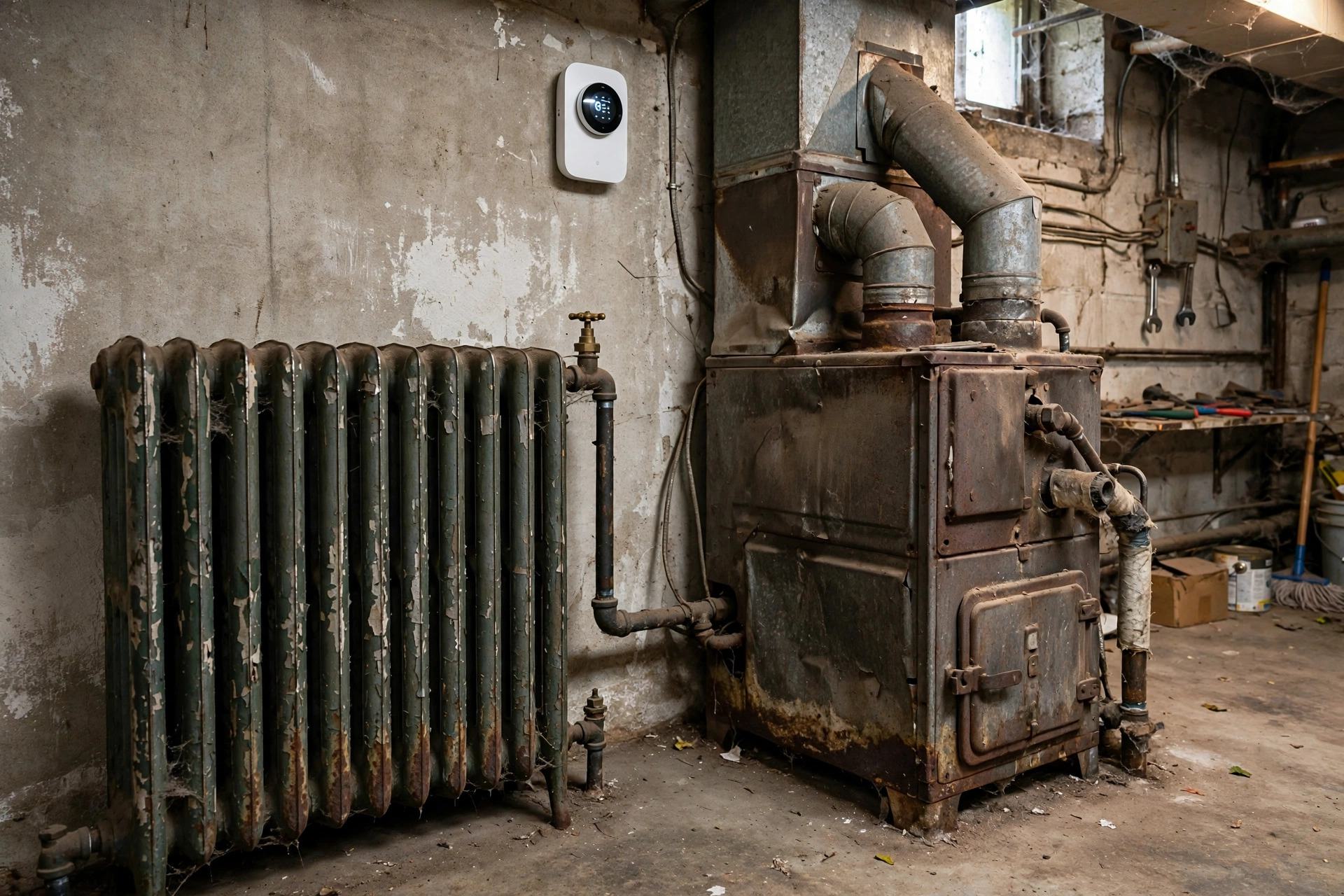
Why old systems complicate the upgrade
Smart thermostats were designed around modern forced-air systems with fat wire bundles and a C-wire for power. Plenty of homes do not have that. Older houses run furnaces from the 90s, boilers with two lonely wires, and thermostat cables installed when the height of technology was a mercury switch. The good news: most of these systems can still take a smart thermostat. The work is in checking compatibility before you buy, not in replacing equipment.
The issues cluster around three things: power (the missing C-wire), system type (boilers and heat-only setups behave differently from forced air), and wiring quirks (unlabeled wires, splices, and cables with no slack). Handle those three and the rest is a normal install.
The C-wire problem, explained
Old mechanical thermostats were switches. They connected wires to call for heat and needed no power of their own. A smart thermostat is a small computer with a Wi-Fi radio and a touchscreen, and it needs continuous power. That power comes from the C-wire, the common wire, which completes the circuit back to the transformer.
Homes wired before smart thermostats existed often skipped the C-wire because nothing needed it. Four wires (R, W, Y, G) was standard; five with a C was a luxury. So the first step of any upgrade in an older home is the same: turn off the breaker, pull the old thermostat off the wall, and look at the wire labels. A wire landed on C means you can buy anything. No C means you need a plan, and there are several good ones.
Your options when the C-wire is missing
A missing C-wire is the most common older-home problem and the most solvable. Pick the fix that matches your thermostat and your comfort with the furnace room.
Use the included adapter. Most ecobee models ship with a Power Extender Kit in the box: a small module that installs at the furnace control board and creates a working C-wire from your existing four wires. Honeywell’s T9 ships with a similar power adapter. These are the simplest fixes because the part is already in the box and the app walks you through it. Two limits worth knowing: ecobee’s kit does not work with heat-only or dual-transformer systems, so check your setup first.
Let the thermostat sip power. The Nest Learning Thermostat is designed to work with or without a C-wire in most homes, drawing power through the heating and cooling wires. Google says only a small fraction of installs need a C-wire or the separate Nest Power Connector. If opening the furnace panel sounds miserable, this is the path of least resistance.
Repurpose a spare wire. Many thermostat cables contain an extra unused wire tucked behind the wall plate. If yours does, and there is a matching spare at the furnace control board, an HVAC tech (or a careful DIYer) can land it on the C terminals at both ends. Free, clean, and permanent.
Run new wire. The nuclear option, and occasionally the right one: if the cable is damaged, too short, or has no spares, pulling a new 5- or 8-wire cable future-proofs the wall for whatever thermostat comes next. This is a job for a pro in most homes.
Boilers, heat-only systems, and other edge cases
Forced air gets all the attention, but plenty of older homes heat with hot water or steam, and the compatibility picture is slightly different.
Hot water boilers pair fine with most smart thermostats. The Nest Learning Thermostat lists radiant and hot water among its supported systems, and Honeywell’s T9 explicitly covers hot water and steam. The wiring is usually simple: often just R and W, sometimes with a C. The catch is the C-wire fix: on a two-wire heat-only system, ecobee’s Power Extender Kit does not apply, so lean toward a thermostat that runs without a C-wire or plan to run new wire.
Steam heat is the trickiest common case. Fewer smart thermostats support it, cycles are long and slow, and anticipator settings from the old thermostat do not translate. Honeywell’s T9 is one of the models that explicitly supports steam. If you heat with steam, verify support on the exact model page rather than assuming.
Electric baseboard heat is the hard no for most of the big names. The Honeywell T9, for example, does not work with line-voltage electric baseboard systems. Baseboard homes need thermostats built for line voltage, which is a different product category entirely.
Which models suit aging equipment
For the typical older forced-air furnace with no C-wire, the Nest Learning Thermostat is the easiest win: it usually installs without touching the furnace wiring at all. If you prefer ecobee’s room sensors and do not mind the control-board visit, the included Power Extender Kit solves the same problem for free.
For boiler homes, check the heat-only caveat above, then choose by ecosystem and preference rather than wiring: both Nest and Honeywell handle the common boiler configurations. For steam, start with the T9’s explicit support and verify from there.
Across all of these, the online compatibility checker each brand provides is worth more than any review. Enter your wire labels and system type, and it will tell you plainly whether the model fits and what the install needs.
A buyer-friendly compatibility checklist
- Photograph the old wiring with labels visible before touching anything, breaker off.
- Count the wires and note whether one lands on C.
- Identify the system: forced air, boiler (hot water or steam), heat pump, or baseboard.
- Run the brand’s compatibility checker with your wires and system type.
- If there is no C-wire, decide your fix: included adapter, power-sipping thermostat, spare wire, or new cable.
- For heat-only two-wire systems, skip adapter-based fixes and favor models that run without a C-wire.
What to do with the old thermostat
If the thermostat coming off your wall is old enough, it may contain a small glass vial of mercury. Do not throw it in the trash. Mercury is hazardous waste, and many areas run thermostat take-back or recycling programs through HVAC wholesalers and local waste authorities. A quick search for mercury thermostat recycling plus your city or county will point you to a drop-off.
Even without mercury, the old unit does not belong in a landfill if you can avoid it. Most municipal e-waste programs accept thermostats. And take a photo of the wiring before you disconnect anything: future you, or the next homeowner, will thank present you.
When to call a pro
DIY covers most thermostat swaps, but older homes produce edge cases. Call a technician if the wires are unlabeled or do not match any diagram, if you find splices or wire nuts inside the wall, if the system is dual-fuel, or if anything about the furnace control board looks unfamiliar. A service visit costs less than a fried control board, and a pro can also land a proper C-wire while they are there, which solves the problem permanently. Label every wire with tape before you disconnect it, even if the labels seem obvious in the moment.
An old HVAC system is not a reason to skip the upgrade. It is a reason to spend ten minutes on compatibility first. Do that, and the install is usually the easy part.