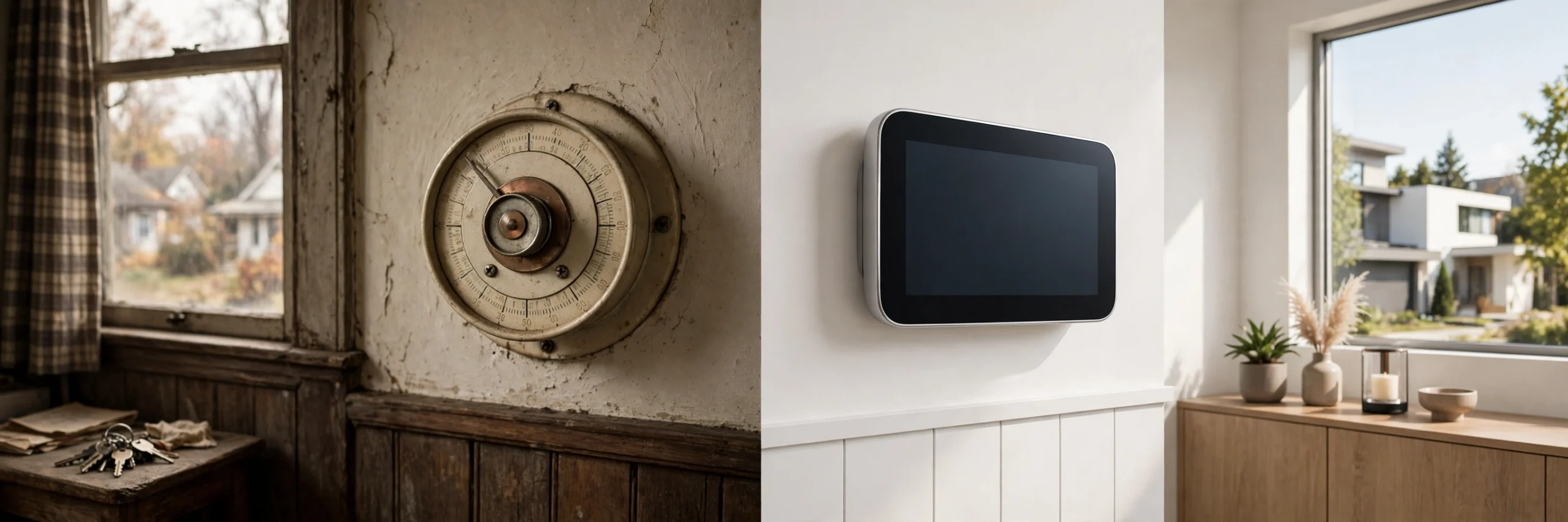
The smart vs programmable thermostat debate has a dirty secret: the humble programmable thermostat on your wall is already good at the core job. It runs schedules, holds temperatures, and asks for nothing. Smart thermostats do not replace that job so much as add layers around it: remote control, learning, sensors, and integrations. Whether the upgrade is worth it depends entirely on which of those layers you will actually use. Here is an honest comparison.
What a programmable thermostat already does well
Give the classic its due. A decent 7-day programmable thermostat:
- Runs different schedules for weekdays and weekends without further input.
- Needs no Wi-Fi, no account, no app, and no firmware updates.
- Keeps working through internet outages, which smart models handle with varying grace.
- Costs little and installs on the same low-voltage wiring in minutes.
- Has nothing to learn, which for many households is a feature, not a bug.
A programmable thermostat set to a thoughtful schedule will outperform a smart thermostat that its owner never configures. The device matters less than the discipline behind it.
What smart actually adds
Remote control from anywhere. Forgot to set back the heat before a trip? Adjust it from the airport. Heading home early? Warm the house from the car. This is the feature owners use most, and programmables cannot touch it.
Learning and auto-scheduling. Higher-end smart models observe your adjustments for a week or two and build a program themselves. Valuable if your routine is irregular; redundant if it is clockwork.
Geofencing. The thermostat notices when the house empties and when someone returns, adjusting automatically. It removes the most common failure of programmable schedules: the routine changed but the program did not.
Energy history and reports. Smart models log runtimes and show when your system works hardest. Data will not lower your bill by itself, but it turns vague intentions into specific tweaks.
Voice control and routines. “Set the bedroom to sleep mode” via a voice assistant, or tie the thermostat into broader scenes like away mode that also locks doors and arms cameras.
Remote room sensors. The standout comfort upgrade. Sensors in the rooms you occupy let the system target actual lived-in temperature instead of hallway temperature.
The honest downsides of going smart
Smart is not pure upside. Wi-Fi is now load-bearing infrastructure for your heating: a dead router or an ISP outage can degrade features, though basic temperature control continues locally on most models. You inherit accounts, passwords, apps, and occasional firmware quirks. Some models need a C-wire or a power adapter kit, adding install complexity. Learning algorithms guess wrong for the first week or two, which irritates precisely the people who bought the device to stop thinking about temperature. And the energy reports are only as honest as the assumptions behind them; treat vendor savings claims as marketing until your own bills confirm them.
Head-to-head comparison
| Programmable | Smart | |
|---|---|---|
| Remote access | No | Yes, via app |
| Scheduling | 7-day manual | Manual, learning, or geofenced |
| Room sensors | No | On mid-range and premium models |
| Energy reports | No | Yes, with varying depth |
| Voice and smart home integration | No | Yes |
| Works without internet | Fully | Basic control yes, smart features no |
| Upfront cost | Low | Moderate to high |
| Setup effort | Minutes | Minutes plus app and Wi-Fi setup |
Installation is the same job either way
One objection to upgrading deserves deflating: the install. Wiring a smart thermostat is the same physical job as wiring a programmable one. Same wall, same low-voltage wires, same terminal letters, same 30 minutes with a screwdriver. The only added work is connecting to Wi-Fi and walking through the app setup, which takes another ten minutes if your network cooperates. If you already installed the programmable yourself, you can install the smart one. If a pro installed it, the swap is an equally quick visit. Installation difficulty is not a reason to stay on a programmable; it is identical on both sides of the decision.
Features that sound great and rarely get used
Marketing sheets list features; real life filters them. The color touchscreen looks premium in photos and becomes invisible within a week, since you control the thing from your phone. Hyper-detailed energy analytics get opened twice, admired, and never opened again by most owners; the basic runtime history is the part that actually informs decisions. Built-in voice assistants on the thermostat itself duplicate the smart speaker already sitting in the room. And “works with” badges for platforms you do not use are decoration. When comparing models, ignore everything you cannot picture yourself using monthly. The features that earn their keep are remote access, sensors, geofencing, and a schedule you will actually maintain. Everything else is showroom appeal.
Who should upgrade
The upgrade pays off for:
- Irregular schedules. Shift workers, freelancers, and frequent travelers get the most from learning and geofencing, because a fixed program never fit them anyway.
- Multi-story homes with hot and cold rooms. Remote sensors solve the problem programmables cannot even see.
- Voice-control households. If the house already runs on a voice assistant, thermostat integration is natural.
- Heat pump owners. Smart models with aux-heat management and gradual recovery handle heat pumps more gracefully than a basic programmable.
- Second homes and rentals you manage. Remote monitoring and control of a property you do not live in is worth the price alone.
Who should keep the programmable
- Clockwork routines. Same wake time, same commute, same bedtime. A well-set 7-day program already captures everything a smart model would do.
- Unreliable Wi-Fi or no interest in apps. If connectivity is flaky or the household will not use the app, the smart premium buys frustration.
- Rentals with swap restrictions. Some landlords forbid thermostat changes; a smart AC controller or sensor setup may serve better than a fight.
- Tight budgets. Money spent on a smart thermostat is money not spent on insulation, sealing, or servicing an aging furnace, which often matter more.
- Households where one person is the entire IT department. Every smart device adds a small but permanent support burden: password resets, app updates, reconnecting after a router change. If you are that person for your household, count the cost honestly. A programmable thermostat never pages you at midnight because the Wi-Fi dropped.
The decision in one paragraph
If your schedule varies, your rooms heat unevenly, or you want control from anywhere, upgrade: the remote access and sensors alone justify it. If your routine is clockwork and your Wi-Fi is an afterthought, keep the programmable and spend ten minutes setting its schedule properly; a disciplined classic beats a neglected smart device every time. And if you are on the fence, there is a middle path many owners take: install the smart thermostat, but run it as a plain programmable for the first month. Use the schedule, ignore the app extras, and see which smart features you actually reach for. The ones you never touch are your answer. One last honest note: whichever you choose, the schedule is what does the work. Do revisit it whenever the seasons change and after any big routine shift, because a program tuned to a life you no longer live helps nobody. The wrong choice is not either thermostat. It is buying the smart one and never opening the app.